Programmes
Turning orbital debris into a resource with DEXTER
DEXTER brings together six European organisations to explore how orbital debris and retired spacecraft can become resources for future missions. The project combines space robotics, in-space processing and propulsion technologies to advance a more circular approach to space infrastructure.
Vimotek is participating in DEXTER — Debris EXtraction Tools for Extra-terrestrial Recycling, a European Innovation Council Pathfinder project exploring technologies to recover and reuse material from end-of-life spacecraft.
Coordinated by Cranfield University, DEXTER brings together organisations from Sweden, Spain, Estonia and the United Kingdom. The four-year project runs from October 2025 to September 2029 and has received approximately €4 million in EU funding.
DEXTER was selected under the EIC Pathfinder Challenge focused on strengthening the sustainability and resilience of EU space infrastructure.
From orbital debris to usable resources
Space debris is normally treated as something to avoid or remove. DEXTER investigates a different possibility: whether material already in orbit can be harvested and reused.
The project addresses two related challenges. The first is the lack of suitable robotic tools for dismantling and processing end-of-life spacecraft. The second is the need for propulsion systems capable of supporting long-duration active debris-removal missions efficiently.
According to the European Commission, DEXTER will investigate two principal pathways for recovering orbital material:
- repurposing recovered material into new structural elements; and
- converting scrap aluminium into propellant for future spacecraft operations.
The aim is to demonstrate that debris can become a useful resource rather than remaining solely an operational hazard.
Robotics, processing and propulsion
DEXTER will develop and validate technologies in laboratory environments before any future orbital application.
Planned work includes robotic systems for harvesting and processing spacecraft material, laser cutting and welding in vacuum, non-destructive gripping technologies and computer vision for semi-autonomous robotic operations.
The project will also investigate processes for converting recovered aluminium into propellant, together with a prototype refuelling mechanism and a refuellable thruster concept for future active debris-removal missions.
These technologies will be assessed against scenarios involving the dismantling and reassembly of spacecraft structures and the reuse of recovered material as fuel.
Vimotek's contribution
Vimotek participates in DEXTER as part of the six-organisation European consortium.
The project intersects directly with Vimotek's work around spacecraft encounters and proximity operations. Recovering material from an end-of-life spacecraft requires a vehicle to approach another object, understand its relative position and geometry, and support robotic operations in close proximity.
Vimotek contributes experience from sensing, perception and the preparation of spacecraft interactions, supporting the wider consortium as it develops technologies for future robotic debris handling and in-space resource utilisation.
Towards a circular space economy
DEXTER is part of a broader shift in thinking about the sustainability of orbital infrastructure.
Removing debris can reduce risks to operational spacecraft. Reusing the material goes a step further: it creates the possibility that existing orbital assets could provide raw material for new structures, propulsion or other future space infrastructure.
The European Innovation Council describes DEXTER as an effort to transform space debris from dangerous clutter into a potentially valuable resource.
For Vimotek, the project applies spacecraft-encounter capabilities in a particularly demanding context: approaching, understanding and ultimately interacting with objects that were never designed to be serviced or reused.
Related stories
Programmes
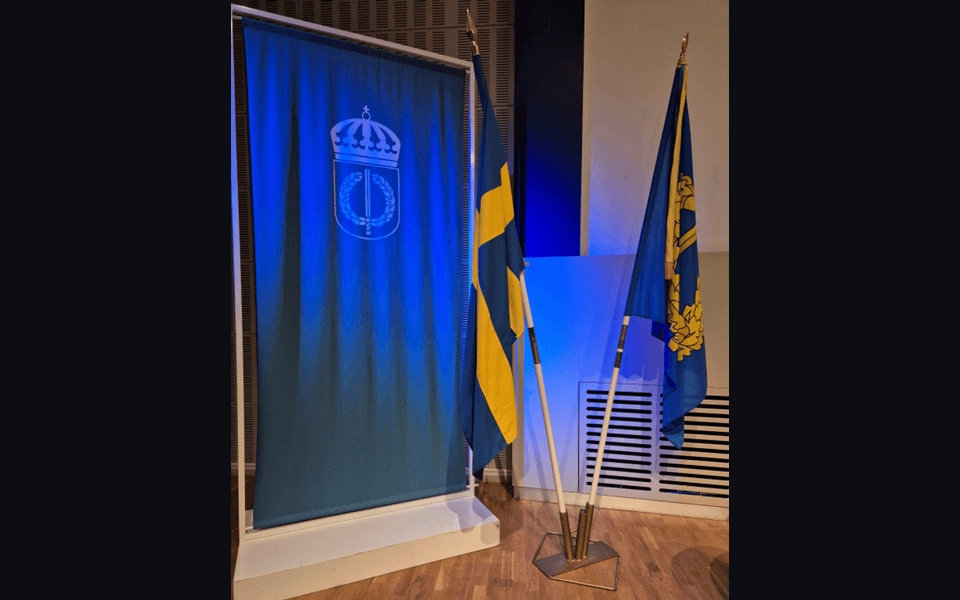
Validating spacecraft-encounter technology for defence applications
Vimotek has participated in Sweden’s Civil-Military Innovation Programme to validate how spacecraft-encounter technology can support defence-related space operations and strengthen Swedish capability.
Programmes
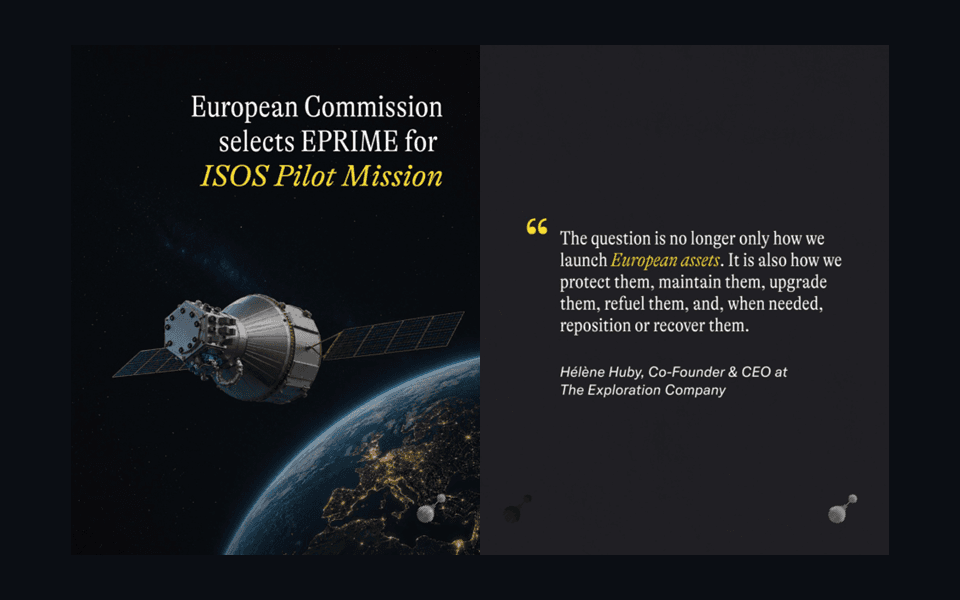
Mission-specific digital twins for Europe’s EPRIME in-orbit infrastructure
Vimotek is contributing to EPRIME, a Horizon Europe project developing a modular European platform for in-orbit logistics, servicing, refuelling and robotic experimentation.
Programmes
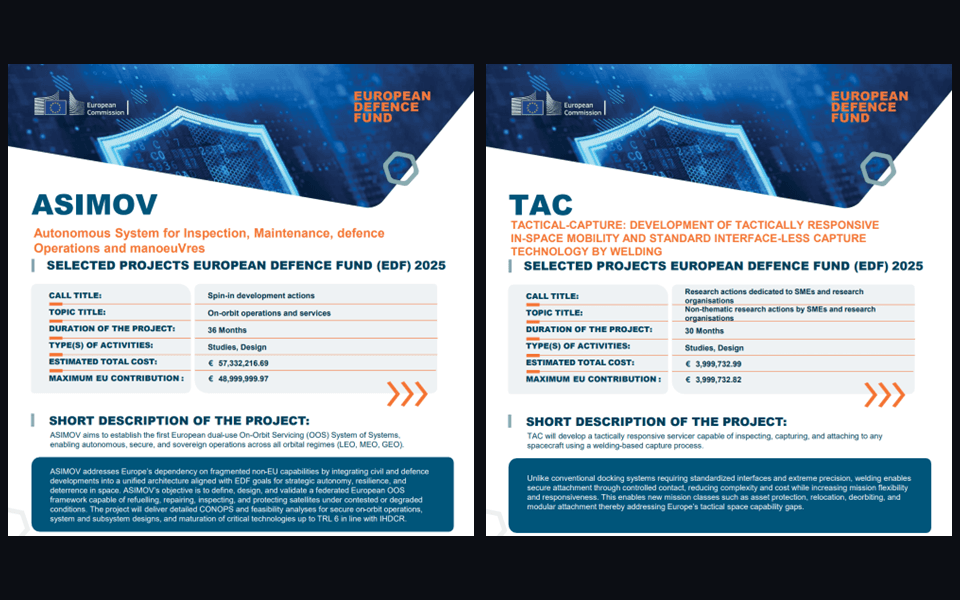
Two new European Defence Fund projects for on-orbit operations
Vimotek is participating in ASIMOV and TAC, two projects selected under the European Defence Fund 2025 programme to advance European capabilities for on-orbit servicing, inspection, capture and secure spacecraft operations.